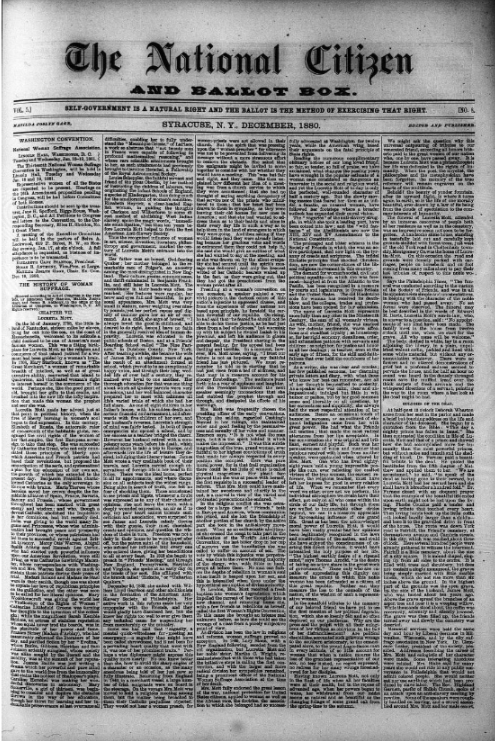
“Its especial object will be to secure national protection to women citizens in the exercise of their rights to vote…it will oppose Class Legislation of whatever form…Women of every class, condition, rank and name will find this paper their friend.”
-Matilda Gage, Prospectus for The National Citizen and Ballot Box, 1878
The Ballot Box was a monthly publication that was produced in Toledo, OH from April 1876 to April 1878 by the Toledo Women’s Suffrage Association with managing editor Sarah R. L. Williams. The publication was created to further the cause of the Women’s Suffrage Movement in the United States and was supported by the National Women’s Suffrage Association.
Due to ill health, Sarah R. L. Williams retired from the publication and Matilda Gage, who was already publishing The National Citizen, bought it and created The National Citizen and Ballot Box.
The National Women’s Suffrage Association
Matilda Gage is a fascinating public figure for her time. To start off with, her parents were not only abolitionists, but her childhood home was used as a stop along the Underground Railroad. So imbued was she in the fight for abolition that her marital home also became a stop on the Underground Railroad, knowing that due to the Fugitive Slave Act, she would face prison if caught.
Her abolition work led to her to the cause of feminism, where in 1852, she was the youngest speaker at the National Women’s Rights Convention, and in the aftermath of the Civil War, she joined Elizabeth Cady Staton and Susan B. Anthony in creating the National Women’s Suffrage Association.
The Women’s National Liberal Union
Despite a strong start with the National Women’s Suffrage Association, Gage often disagreed with her fellow suffragettes who found her views to be “too radical.” Things came to a head when the conservative American Women’s Suffrage Association merged with the National Women’s Suffrage Association to create the National American Women’s Suffrage Association, an organization whose sole purpose was to win the vote for women and pass temperance legislation, a merger opposed by both Elizabeth Cady Staton and Gage because they felt that the new organization’s goals were crossing the line between church and state.
In response, Matilda Gage founded the Women’s National Liberal Union. During her lifetime, Matilda Gage was deeply critical of;
- the government mixing with religion, going so far as to advocate for a Consitutional Amendment outlining the separation of church and state;
- the federal government’s response to Native Americans and having citizenship thrust upon them, instead of the treaties that they had entered into with the United States being honored and recognizing their status as separate nations;
- while not completely in opposition of abortion, Gage felt that men abused the privilege of their ownership over their wives and the practice allowed men to maintain status and wealth by forcing their wives to undergo the procedure;
- concerned with the rights of women over their own body;
- worked hard to recognize women inventors to ensure that they got the credit for their work, which their husbands were in the habit of stealing.
In short, Matilda Gage and her radical views, some of which are still seen as radical in today’s society is the very heart of this endeavor. She acted when she saw injustice, speaking out in public during her speeches, and worked her whole life to codify her beliefs in this country, and through her work and activism, we stand on her shoulders.